
A Wood Awakening
Inside the living habitat we are restoring for the island’s red squirrels, and why Isle of Wight businesses are invited to sponsor our 2027 calendar.
There is a particular quality to a March woodland that no photograph can fully capture: the way light falls through canopies not yet in leaf, pooling across a floor still littered with last autumn’s oak leaves, and the first brave green shoots pushing through as if testing the air. Recently our founder and Chair Person Helen Butler Mbe took her camera into the woodland and tried anyway.
What she brought back is a small document of transformation, a woodland in the middle of becoming something richer, wilder and more resilient than it has been for decades. Our 2027 Isle of Wight Red Squirrel Trust calendar, meanwhile, is being shaped by the brilliant photographers of the Isle of Wight, whose extraordinary images of the island’s red squirrel population we are now inviting local businesses and sole traders to sponsor.
The Woodland Floor
Counting Bluebells — a small miracle


Native bluebells are one of the most reliable indicators of ancient woodland, and the Isle of Wight holds some of the finest remaining colonies in southern England. here in our woodland, they tell a precise story of what habitat restoration can do.
“The smaller patch has grown from 2 plants to 6. Each one a vote of confidence, from mother earth herself, in what we are doing here.”
The larger glade has expanded considerably this spring, and this is a direct result of the selective clearance work our volunteers carried out through the winter. They have worked diligently to open the canopy just enough to let the light reach the bulbs. The smaller satellite colony, which we’ve been watching anxiously, has tripled in just twelve months: two plants became six. It sounds modest. In bluebell terms, it is a triumph.
Ancient woodland bluebells spread at roughly six inches a year. A thriving colony is not planted; it is earned, over many patient decades of right conditions. What you see in these photographs is the reward of that patience, and the product of careful, purposeful intervention.

A View from the Partially-Built Hide

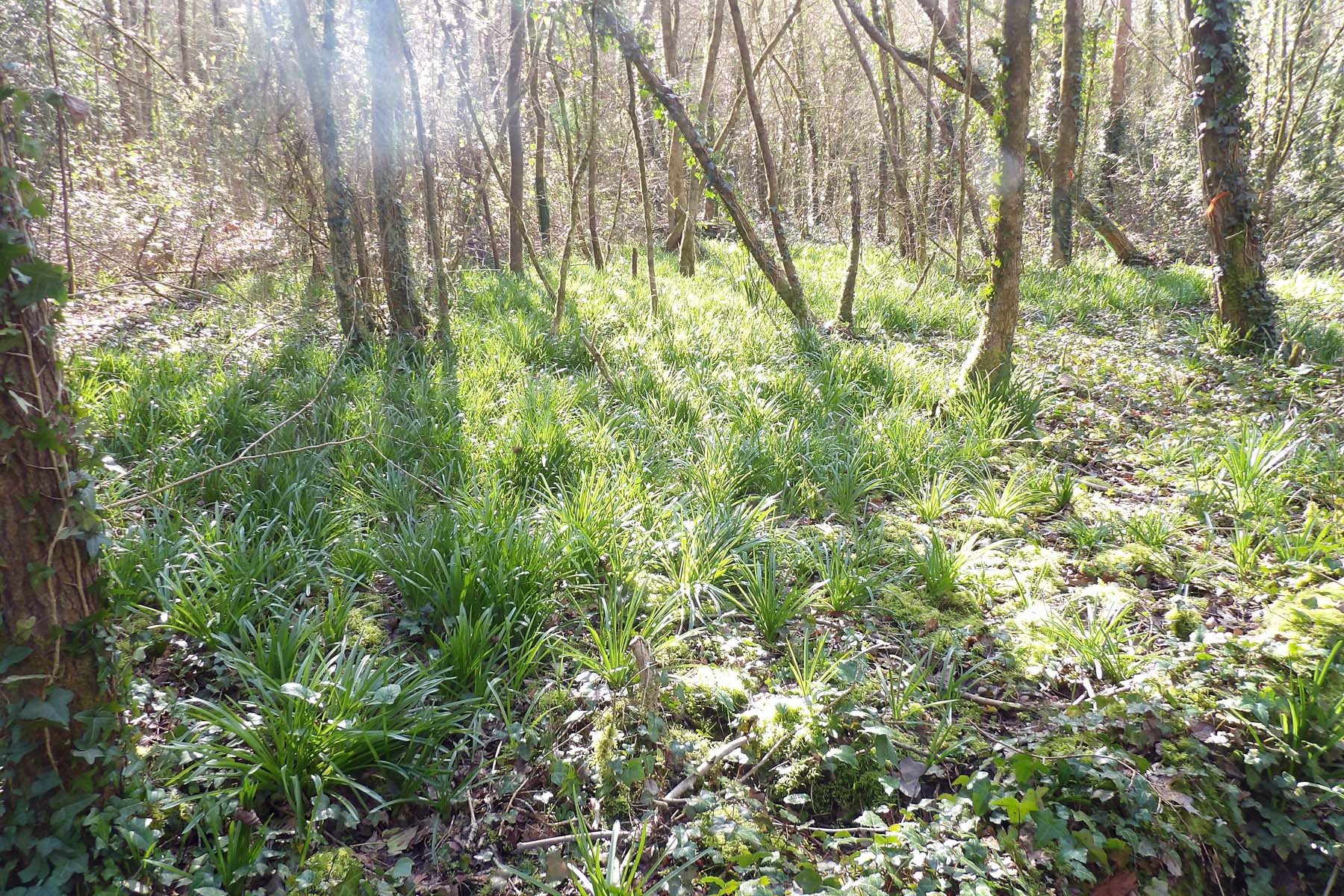
Our hide is still under construction, but recent sunshine has been too good to waste. Helen took up position at the edge of the developing structure to capture a hint of what the view from the finished hide will be.
What has struck us most is the sheer density of ground-layer activity. The bluebell shoots are up, but so are wood sedge, and a dozen other species we’re still cataloguing. The ivy, which can be a bully if left unchecked, is for now holding its ground alongside rather than overwhelming them.
This layered complexity is precisely what red squirrels need. They aren’t just a canopy species; they use every level of a woodland structure in the course of a day. A rich ground layer means insects, fungi, fallen seed, and shelter. Each plant we protect or encourage ripples upward through the food chain.
Narrow-Leaved Lungwort — a rarity in the leaf litter

If the bluebells are the woodland’s most theatrical performers, the narrow-leaved lungwort is its quiet celebrity. Pulmonaria longifolia is a nationally scarce plant, found in only a handful of sites in southern England, and the Isle of Wight holds some of the country’s finest populations.
Those distinctive white-spotted leaves are unmistakable once you know them, and finding them thriving here, nested in last year’s leaf fall, is one of the clearest signals that this woodland retains something genuinely rare. It doesn’t survive in disturbed ground. Its presence tells us the soil beneath our feet has been undisturbed for a very long time.
This is the sort of subject that stops you in your tracks, not the drama of a leaping squirrel, but the quiet insistence of a plant doing exactly what it has done for centuries, asking only that we do not destroy the conditions that sustain it. It is precisely the kind of story that we seek to encourage and witness in our woodland across 2026, 2027 and beyond…
Standing, Falling, and Starting Again


The tree story in our woodland is more complicated than the flowers and, in its way, more dramatic. We have been blessed to acquire and now be managing a mixed woodland. Here significant areas of conifer, planted in the mid-twentieth century, have outcompeted and shaded out the native broadleaf species beneath them. The work of restoration involves carefully, selectively removing trees, which sounds counterintuitive, but is essential.
There is also a less controllable process at work. Many of the Western red cedars have hearts that are rotting from the inside. The exterior bark tells you nothing; crack one open and you find a hollow, crumbling core. The chainsaw reveals it only once it’s too late for that particular tree, but the sawdust it throws across the ground is itself a kind of gift, nitrogen-rich and full of fungal spores, it is effectively, a starter pack for the organisms that underpin woodland life.


These falling trees are natural, but they do create real hazards. Every significant wind event brings down more, and some of those falls are unpredictable. Our volunteers are trained, cautious, and appropriately equipped, and we have been enormously fortunate to benefit from the generosity of another generous, anonymous donor who provided our chipper and has now pledged additional tools we need to work safely and effectively.
Much of the felled timber is not removed. It stays in the wood as deadwood habitat, some of the most ecologically valuable ground in any ancient woodland. The invertebrates that colonise a rotting log underpin the entire food web above them.
2027 Conservation Calendar
Sponsor a Page. Support the Island.
Our 2027 calendar showcases the extraordinary wildlife and landscapes of the Isle of Wight through the lenses of the island’s own brilliant photographers. It is a publication that will sit on desks and walls across the island and beyond for an entire year, and we have two ways for your business to be part of it.
Month Sponsorship
£150
12 opportunities — one per month
Your business name and logo featured prominently across your sponsored month’s full page
Listed as a supporter in all promotional print and digital materials
One complimentary calendar (additional copies available to purchase)
Direct funding of Isle of Wight red squirrel conservation, publicly demonstrating your commitment to both red squirrels and a dedicated Isle of Wight charity
Supporter Square
£30
12 opportunities — these businesses will have their logos featured together on a shared page.
Your business name featured in a supporter square on our shared supporter page
Listed as a supporter in digital promotional materials
One complimentary calendar (additional copies available to purchase)
A meaningful, affordable way to ally with us and publicly demonstrate your commitment to both red squirrels and a dedicated Isle of Wight charity.
Whether you’re a sole trader wanting to show your values or an established business looking for year-long local visibility, there’s an opportunity here for you. All proceeds go directly to red squirrel conservation on the Isle of Wight.
For more information on sponsorship and to secure your slot click here