
Signs of Spring: A Morning of Wonderful Woodland Discoveries
The Return of the Narrow-Leaved Lungwort
Pulmonaria angustifolia
The highlight of the morning came when our founder, Helen Butler MBE, relocated a patch of narrow-leaved lungwort (Pulmonaria angustifolia) she had first noted during a survey last year. It was a genuine test of a naturalist’s eye, the plant had been hidden underneath a dense smothering of red oak leaves and ivy, leaving it pale, fragile, and fighting for survival.
Narrow-leaved lungwort is one of Britain’s rarest and most beautiful spring wildflowers, producing vivid blue blooms that are a vital early nectar source for bees emerging from winter. Finding it persisting despite such difficult conditions was both moving and motivating.

???? The narrow-leaved lungwort, spotted by Helen, pushing through the leaf litter beneath suppressing ivy and red oak debris.
Helen and the woodland volunteer team are now actively working to remove some of the encroaching red oak canopy in this area to let more light reach the woodland floor. This kind of sensitive, targeted intervention is exactly what rare species like lungwort need, a little breathing room, and the chance to do what they do best.
Also Spotted
Bluebells Hanging On
Hyacinthoides non-scripta
Alongside the lungwort, Helen also came across a small cluster of bluebells (Hyacinthoides non-scripta), England’s most iconic woodland wildflower, doing their best to reach towards the light. At this early stage of spring, only the narrow green shoots are visible, but they represent real promise.
The UK holds an estimated half of the world’s entire bluebell population, making these woodland carpets a genuine global treasure. Yet, like so many woodland specialists, they are sensitive to deep shade and competition. The work being done to open the canopy will directly benefit them too.

???? Early bluebell shoots pushing through the leaf litter — a hopeful sign of the carpet to come, if we can give them the light they need.
Wildlife Sighting
The Brimstone Butterfly: Spring’s Earliest Flier
Gonepteryx rhamni
“It’s always the brimstone that tells you spring has truly arrived — that flash of sulphur yellow through the bare branches.”
— Helen Butler MBE
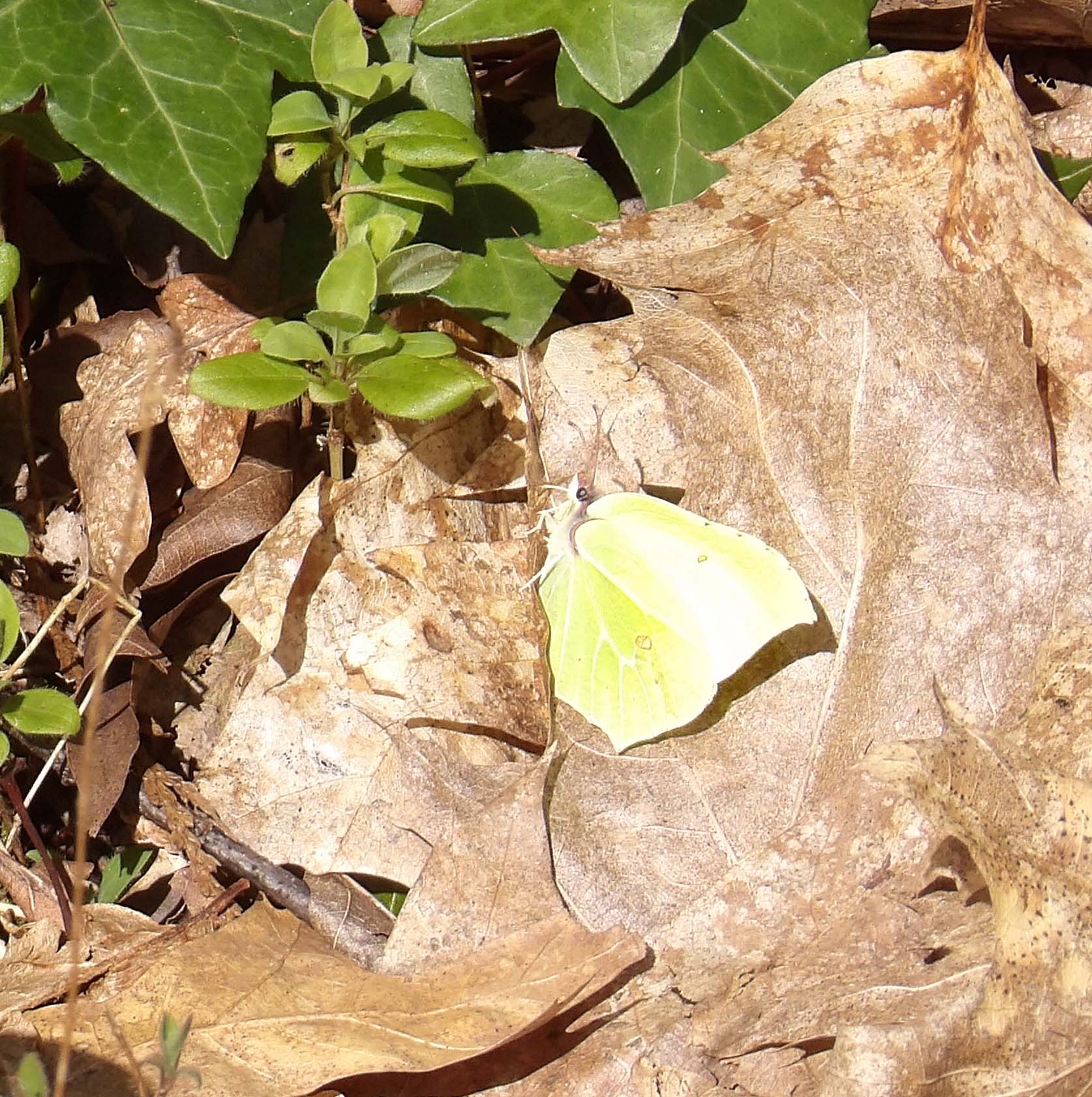
The brimstone butterfly (Gonepteryx rhamni) has been a regular presence over the past week, and Helen managed to photograph one resting on the leaf litter, a surprisingly tricky shot, as these butterflies are masters of disguise when their wings are closed, mimicking a leaf perfectly with their pointed wingtips.
Brimstones are one of Britain’s longest-lived butterflies, overwintering as adults and emerging on the first warm days of late winter and spring. Their lemony-yellow wings (on males) have even been credited with giving us the word “butterfly” , the “butter-coloured fly.” As we have indicated here, spotting one is always a reliable sign that the season is turning.

???? A brimstone butterfly at rest — almost invisible against the dead leaves, with its distinctive leaf-shaped wings fully closed.
Curious Finds
“Disgusting” and Delightful: The Woodland’s Fungi
Fungi · Unidentified
Not all of the morning’s discoveries were conventionally beautiful. Appropriately enough given the recent cofirmation of Isle of Wight Mushrooms as our 8th 2027 calendar sponsor; Helen, never one to mince words; described two fungi finds with characteristic candour: “disgusting slimy fungi” and “funny looking white fluffy fungi.”
The dark, glistening, jelly-like growth erupting from a decaying log is likely one of the slime moulds or a wet-season bracket fungus, remarkable organisms that remind us just how much unseen life is at work in the woodland, breaking down dead wood and recycling nutrients back into the soil. Meanwhile, the white, powdery encrustation on the second branch is characteristic of a crustose lichen or a wood-rotting fungal mycelium. Neither species has been formally identified yet, can any of our followers help?

???? The “disgusting slimy fungi” A glistening and gelatinous on a rotting log. Species TBC!

???? The “funny white fluffy fungi” A pale, crustose growth coating a fallen branch. Any mycologists out there?
These fungi are not merely curiosities — they are keystone organisms in any healthy woodland ecosystem, accelerating the decomposition of dead wood that might otherwise take decades to break down. The fallen logs and branches in our woodland are not tidied away for exactly this reason: they are habitat, larder, and nursery all at once.
Why This Work Matters
This morning’s finds are a microcosm of the challenges facing ancient woodland across the UK. Invasive non-native species like red oak (Quercus rubra), planted historically across British woodlands, cast a deep and prolonged shade that outcompetes slower-growing native shrubs and wildflowers. Ivy, too, while native and valuable as habitat, can form dense ground-covering mats that exclude light-hungry species like lungwort and bluebell.
Without active volunteer effort, species like narrow-leaved lungwort which are already rare nationally, can quietly disappear beneath a smothering of leaf litter and shade, unnoticed and unmourned. Finding it, protecting it, and giving it light is exactly why we’re here.
In summary, recent woodland work / discoveries are as follows:
- Relocated and recorded the rare narrow-leaved lungwort population
- Began removal of red oak to improve light on the woodland floor
- Documented bluebell emergence sites for ongoing monitoring
- Photographed and recorded brimstone butterfly activity
- Noted and photographed unidentified fungi for community identification
Every visit, every record, every hour of practical conservation work adds up. If you’d like to join Helen and the team, new volunteers are always welcome. No experience necessary, just a love of the natural world and a willingness to get your boots muddy.
2027 Isle of Wight Red Squirrel Trust Calendar
Sponsor a Page. Support the Island.
Our 2027 calendar showcases the extraordinary red squirrels of the Isle of Wight through the lenses of the island’s own brilliant photographers. It is a publication that will sit on desks and walls across the island and beyond for an entire year, and we have two ways for your business to be part of it.
Month Sponsorship
£150
12 opportunities — one per month (only 4 remaining)
- Your business name and logo featured prominently across your sponsored month’s full page
- Listed as a supporter in all promotional print and digital materials
- One complimentary calendar (additional copies available to purchase)
- Direct funding of Isle of Wight red squirrel conservation, publicly demonstrating your commitment to both red squirrels and a dedicated Isle of Wight charity
Supporter Square
£30
12 opportunities — logos featured together on a shared page (only 8 remaining)
- Your business name featured in a supporter square on our shared supporter page
- Listed as a supporter in digital promotional materials
- One complimentary calendar (additional copies available to purchase)
- A meaningful, affordable way to ally with us and publicly demonstrate your commitment to both red squirrels and a dedicated Isle of Wight charity
Whether you’re a sole trader wanting to show your values or an established business looking for year-long local visibility, there’s an opportunity here for you. All proceeds go directly to the isle of wight red squirrel trust and the work that we do here on the Isle of Wight.
For more information on sponsorship and to secure your slot click here.